Full-Cycle Metal Fabrication: Why One Contractor Is the Most Efficient Choice
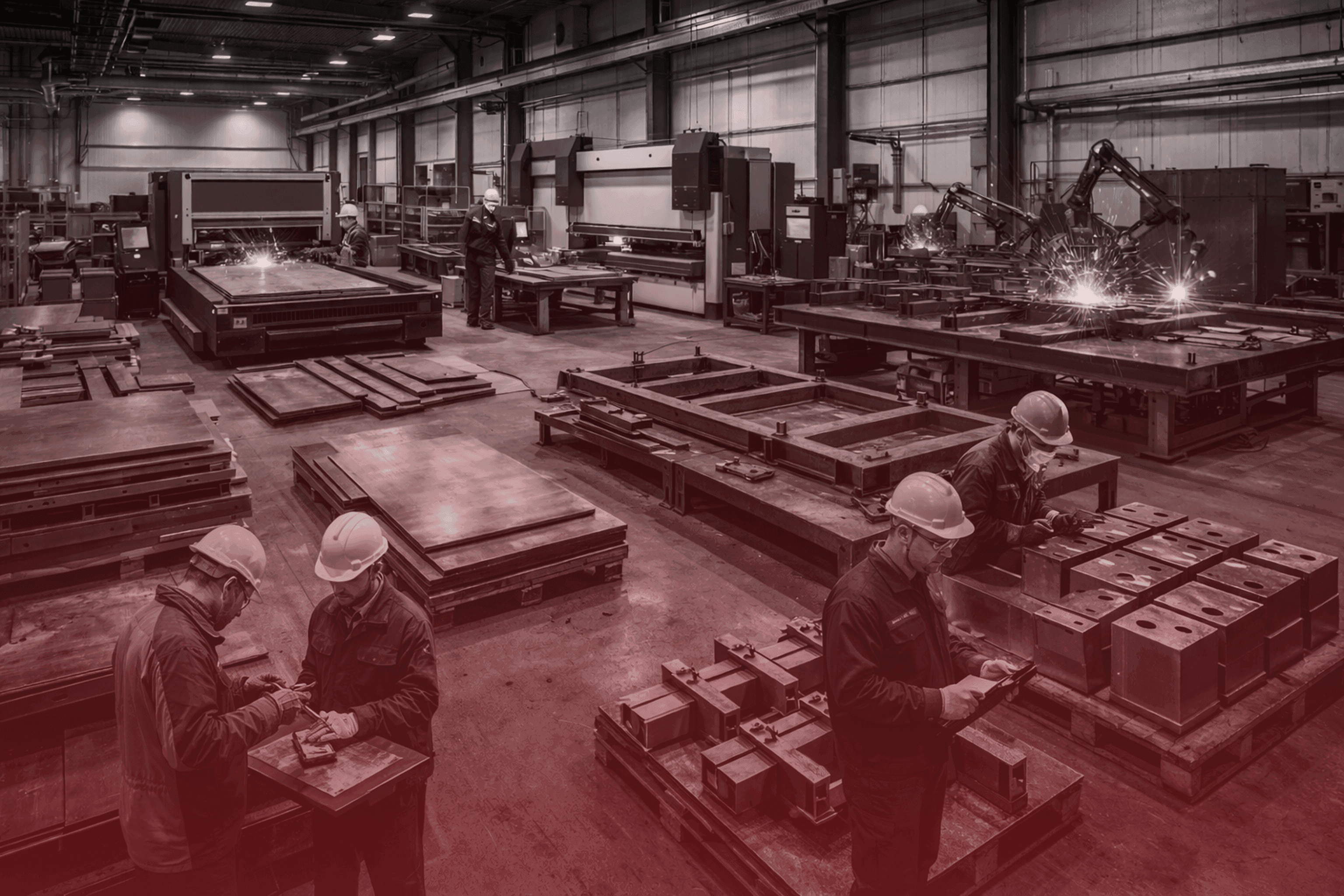
In modern manufacturing, sheet metal fabrication isn’t just about cutting or welding metal.
It’s a complex system of interlinked metal fabrication processes, each depending on precision, timing, and compatibility.
When every stage from laser cutting to powder coating is handled by different vendors, things can go wrong: drawings get distorted, deadlines slip, and process tolerances don’t match. We’ve seen this many times at Metalworkshop before clients finally came to us for a full-cycle solution.
For over 10 years, we’ve specialised in turnkey metal parts fabrication. In this article, we’ll explain why it’s smarter to keep the entire production cycle under one roof, review the core sheet metal fabrication techniques, and share a real-world case from our production floor.
What Is Metal Fabrication?
Metal fabrication is a set of technological processes that shape, form, and finish metal into a functional end product.
In simple terms, everything from laser cutting to powder coating is part of the same sheet metal fabrication process.
Core Metal Fabrication Processes
To turn a sheet into a finished component, most projects go through five to seven key stages.
1. Sheet Metal Cutting (Laser, Waterjet, Plasma)
This is the first and most accurate stage. A laser beam cuts with precision up to ±0.1 mm and minimal heat distortion.
Learn more about laser cutting →
2. Sheet Metal Forming (Bending, Stamping, Rolling)
After cutting, parts are shaped using CNC press brakes and rollers to achieve complex geometries without damaging the material’s structure.
See metal bending services →
3. CNC Turning and Milling
Turning produces cylindrical or conical forms; milling shapes surfaces, grooves, and contours.
Our metal fabrication workshop uses multi-axis CNC machines with repeatability of ±0.01 mm.
Explore our machining services →
4. Sheet Metal Welding (Laser, TIG, MIG)
Welding unites elements into one structure. Depending on material and thickness, we use MIG, TIG, or laser welding for precision and strength.
The finishing stage adds corrosion protection and visual appeal. Powder coating ensures durability for up to 20 years.
See powder coating services →
Applications of Sheet Metal Fabrication
Full-cycle sheet metal processing is crucial wherever precision and workflow synchronisation matter most:
Machinery and equipment manufacturing
Energy and engineering systems
Construction of steel structures
Food and pharmaceutical industries
Advertising frames and designer furniture
In all these areas, precision down to tenths of a millimetre prevents rework, waste, and costly downtime.
Why It’s Better to Work with One Full-Cycle Metal Fabrication Contractor
When every stage from CAD to coating is handled by one team, you get not just a service but a predictable result.
Consistent Quality Control at Every Stage
Every part undergoes verification after each process: laser cut accuracy, bend angle, weld strength, and coating thickness.
At Metalworkshop, we maintain in-house QC standards that match ISO 9001:
dimensional control using digital callipers and 3D gauges,
weld testing by ultrasound,
coating thickness measured by electronic gauges.
This ensures metal fabrication quality that meets EU standards and client tolerances.
Fewer Logistical and Communication Risks
When multiple shops share one drawing, communication turns into chaos.
With full-cycle sheet metal fabrication, all experts, engineers, designers, welders, and painters sit at the same table.
One project, one responsible team. No lost drawings, no delivery delays.
Time and Cost Efficiency
Each vendor hand-off means extra time, repackaging, transport, and coordination.
Working with Metalworkshop reduces total lead times by 30–40 %, as all fabrication of sheet metal stages are synchronised under one production plan.
Process Compatibility and Technical Integrity
When all metal fabrication techniques happen within the same facility, parameters align perfectly.
For instance, after laser cutting, parts move directly to CNC bending without recalculating coordinates; after welding, parts go straight to powder coating, following in-house cleaning and sandblasting.
Everything runs within a single controlled cycle, ensuring geometry and finish consistency.
How to Choose the Right Full-Cycle Metalworking Partner
Choosing the right metal fabrication manufacturer is half the project’s success.
Here’s what to look for:
Proven Experience and Portfolio
Experience isn’t about years in business — it’s about completed projects.
Metalworkshop produces metal parts fabrication for industries ranging from food equipment to industrial platforms, selecting materials and technologies for each load and environment.
Modern Metalworking Equipment and CNC Technology
Always check that your supplier owns in-house machinery: laser systems, CNC turning centres, welding stations, coating booths.
We operate on Trumpf, Durma, and Gema systems — synonymous with precision, repeatability, and reliability.
Full Range of Services
The wider the scope, the easier the coordination.
An ideal partner offers end-to-end sheet metal fabrication process support:
design,
cutting,
machining,
welding,
finishing,
and delivery.
Customer Feedback and Industry Reputation
Trust comes from transparency.
At Metalworkshop, over 200 corporate clients and dozens of long-term partners return to us year after year — proof that we deliver results, not just parts.
Real-Life Example of a Full-Cycle Metalworking Project
A client approached us to produce a batch of metal enclosures for electrical cabinets.
The requirements: high-dimensional accuracy, zero assembly gap, and durable powder coating.
Production stages:
Design: 3D modelling in SolidWorks with stress analysis.
Laser cutting: precision ±0.1 mm.
Bending: performed on a Durma press brake with spring-back compensation.
Welding (MIG/TIG): ensured rigidity with minimal deformation.
Surface prep: sandblasting and degreasing.
Powder coating: polymerised at 190 °C, coating thickness = 80 µm.
Result: 50 enclosures produced in 12 days; final geometry held within ±0.2 mm; coating passed adhesion and impact tests.
FAQ
Frequently Asked Questions
It’s the complete set of processes from cutting to coating that transform raw sheet metal into finished parts and structures.
CNC automation, laser welding, powder coating systems, digital measurement, and 3D CAD modelling.
Actually, no — it’s cheaper overall.
Working with one full-cycle fabrication partner cuts logistics, coordination, and rework costs by 15–25 % compared with using multiple suppliers.