


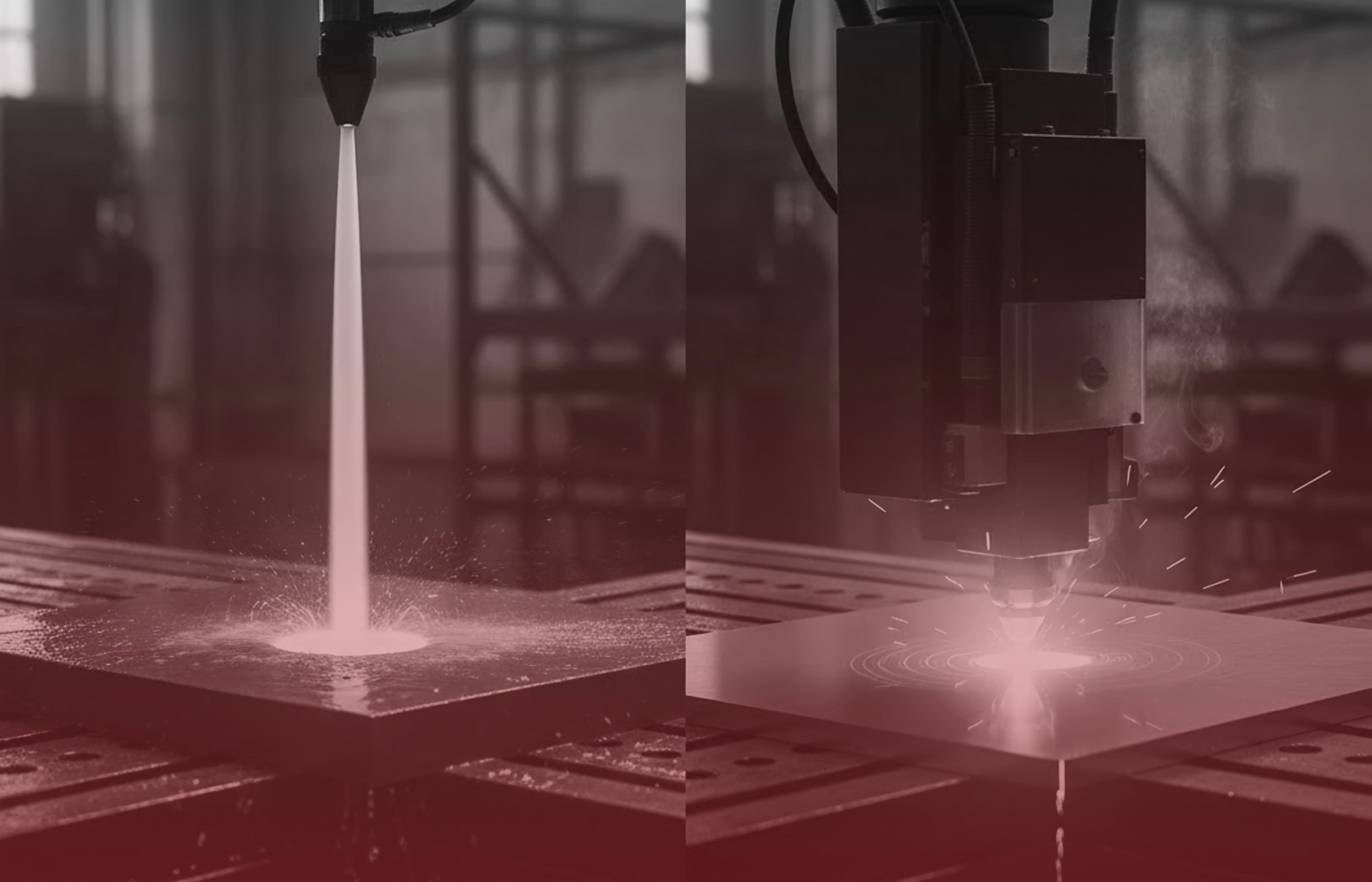
How to Choose Between Waterjet and Laser Cutting for Metal?
What is Waterjet Cutting?
Waterjet cutting is a process where a high-pressure stream of water mixed with abrasive particles cuts through metal and other materials.
How Waterjet Cutting Works
Pressure: up to 4,000 bar.
Abrasive: typically garnet, mixed into the water.
Jet speed: up to 900 m/s, with a stream diameter as fine as 0.1–1 mm.
The cut happens without heat — no melting, no thermal stress.
That’s why this method is also called metal cutting with water. It’s ideal for heat-sensitive materials.
Advantages of Waterjet Cutting
Can cut very thick metal (up to 200 mm).
Suitable for stainless steel, titanium, copper, brass, and aluminum.
No heat-affected zone — material properties remain unchanged.
High precision for complex contours.
Extremely versatile: works on stone, glass, and composites too.
Disadvantages of Waterjet Cutting
Slower than laser cutting.
Requires large amounts of water, and abrasive.
Higher operating costs (consumable nozzles and abrasive).
What is Laser Cutting?
Laser cutting uses a concentrated laser beam to heat and melt metal along a programmed path.
How Laser Cutting Works
Beam diameter: ~0.1 mm.
Temperature in the focus: several thousand degrees.
Melted material is blown away by assist gases (nitrogen, oxygen, air).
Specialized setups exist: laser cutting aluminum often requires nitrogen, while laser tube cutting uses rotating chucks.
Advantages of Laser Cutting
Very fast cutting of sheets up to 20 mm thick.
Excellent accuracy (tolerance up to ±0.1 mm).
Smooth, clean edges without extra finishing.
Highly efficient for serial production and complex shapes.
Disadvantages of Laser Cutting
Limited thickness: cutting above ~25 mm is inefficient.
High cost of equipment and maintenance.
Reflective metals (copper, brass) need special settings.
Laser Cutting vs. Waterjet Cutting: Comparison
Cut Quality and Precision
Laser cutting delivers smooth, clean edges with minimal finishing.
Waterjet cutting leaves a slightly rougher edge but keeps the material stress-free.
Materials and Thickness
Laser cutting works best on thin to medium sheets (up to 20–25 mm).
Waterjet cutting handles extra-thick plates (up to 200 mm) and brittle materials.
Speed and Productivity
Laser cutting is 2–3× faster in high-volume production.
Waterjet is slower but much more flexible in what it can cut.
Cost
Laser cutting is more economical for large batches.
Waterjet is costlier due to abrasive, but often the only option for certain materials.
Comparison Table
Metal thickness
Edge quality
Materials
Speed
Cost
Heat effect
Laser Cutting Services
up to 20–25 mm
Smooth, no finishing
Steel, aluminum, tubes, alloys
Very high
Efficient for series
Minimal heat zone
Waterjet Cutting Services
up to 200 mm
May require light grinding
All metals, glass, stone, composites
Slower
Higher for mass jobs
No heat at all
How to Choose the Right Cutting Method for Your Project
Need fast production of sheet metal parts up to 20 mm → laser cutting.
Cutting thick plates, composites, or fragile materials → waterjet cutting.
For aluminum and tubes → laser cutting systems with special setups.
For stainless steel or titanium in large thicknesses → waterjet steel cutting
The right choice depends on thickness, material, and budget.
FAQ
Yes, but only up to ~20–25 mm effectively. Beyond that, waterjet is recommended.
Yes, waterjet cutting works perfectly on stainless steel of any thickness.
Titanium, stainless steel, aluminum, copper, brass, and also composites or brittle materials.