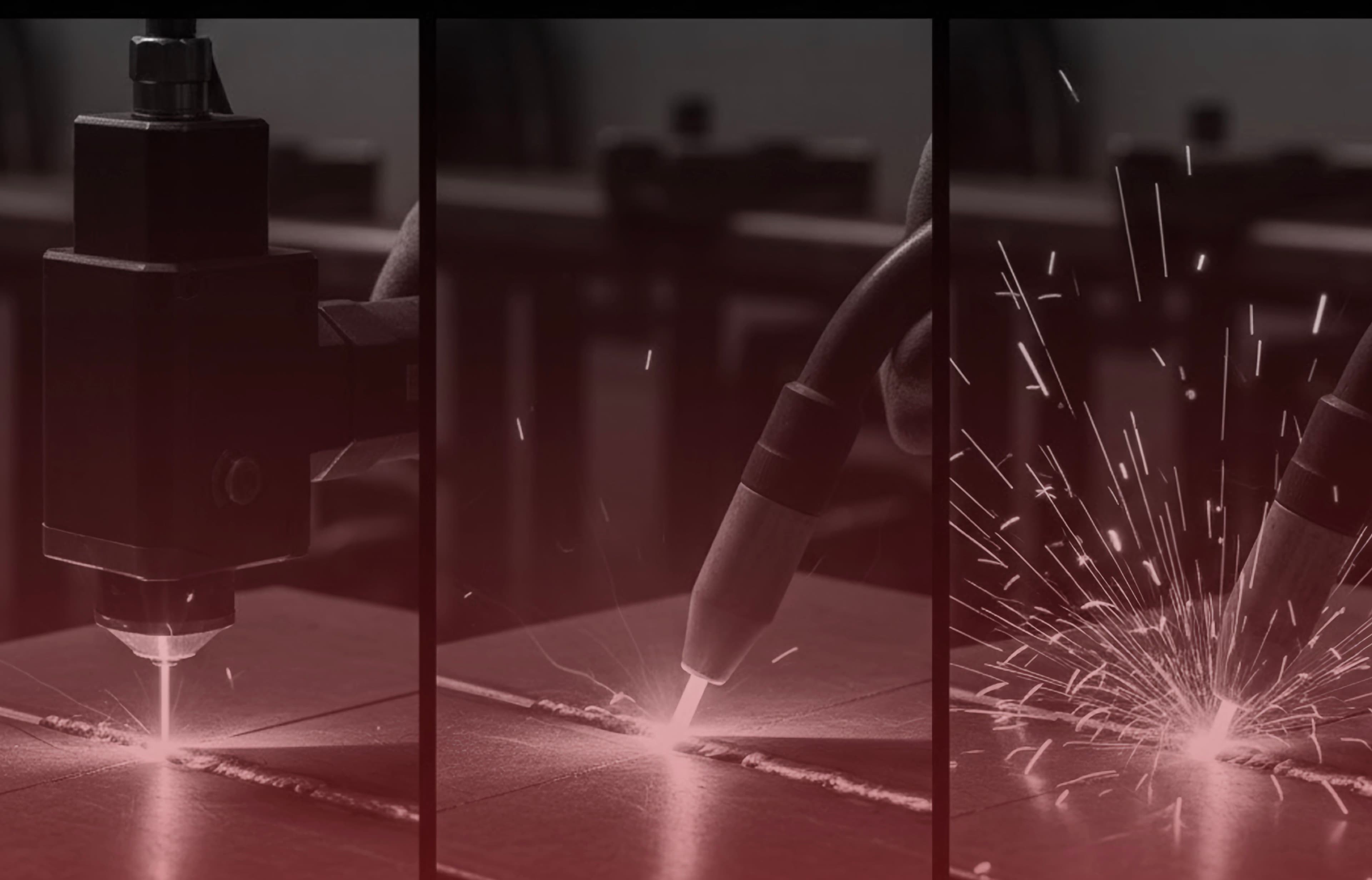
Overview of Common Welding Methods Today
MMA / Manual Metal Arc Welding (SMAW)
Ручне дугове зварювання — це класика, з якої починали майже всі. Електрод створює дугу між собою й металом, розплавляючи крайки та утворюючи шов.
Переваги: універсальність, мобільність, доступність обладнання.
Недоліки: нижча продуктивність, залежність якості від досвіду зварювальника.
Де застосовуємо: вже майже ніде, адже технологія трохи застаріла; інколи використовується для монтажу у польових умовах, конструкцій з чорних металів.
MIG / MAG Welding
Manual arc welding — also known as MMA or stick welding — is the classic, time-tested method most welders start with. An electrode creates an electric arc that melts the metal edges and forms the weld joint.
Advantages: highly versatile, portable, inexpensive equipment.
Disadvantages: slower process, weld quality depends heavily on the operator’s skill.
Applications: mostly phased out in modern production, but still used for on-site assembly, heavy steel structures, and repair work.
TIG Welding
TIG welding (Tungsten Inert Gas) uses a non-consumable tungsten electrode and an argon gas shield to produce clean, precise welds.
Advantages: exceptional control and cosmetic appearance, perfect for thin sheets and high-precision metal welding.
Disadvantages: slower than MIG, requires experienced operators.
Applications: stainless steel, aluminum, and non-ferrous alloys.
Typical uses: fabrication of food-grade tanks, medical devices, or stainless architectural details.
Spot Welding
Spot welding joins metals by applying short bursts of current and pressure between two electrodes. The localized heat melts the interface, creating a small weld nugget.
Advantages: extremely fast, easy to automate, no filler materials required.
Disadvantages: limited to sheet metal, unsuitable for thick materials.
Applications: automotive manufacturing, appliance housings, and enclosure assembly.
Laser Welding
Laser welding is a high-precision process that uses a concentrated laser beam to melt and fuse metals.
Advantages: minimal heat-affected zone, unmatched accuracy, easily automated.
Disadvantages: higher equipment cost and strict setup requirements.
Best for: thin components, micro-welding, and high-tech or decorative parts.
Typical products: aluminum housings, sensors, and electronic components.
Other Methods
Other welding techniques include plasma arc, friction stir, and electron-beam welding — mainly used in aerospace, energy, or high-precision industries. These specialized processes represent the cutting edge of welding technology, where tolerances are measured in microns.
Top Factors to Consider When Selecting a Welding Method
Material Type
Aluminum and stainless steel work best with TIG welding. Carbon steel performs great with MIG or arc welding. For copper, brass, or reflective materials, laser welding ensures clean results without oxidation.
Material Thickness
Thin sheets (under 2 mm) — choose TIG. Medium thickness (2–8 mm) — MIG/MAG. Thick sections — arc welding or submerged arc for deep penetration.
Weld Joint Type & Geometry
Butt and corner joints suit MIG; tube and pipe welding works best with TIG; overlapping joints — spot welding.
Quality and Aesthetic Requirements
When the visual quality of the seam matters — TIG or laser welding. When speed matters more than perfection — MIG.
Productivity and Volume
For mass production, automated MIG or laser welding systems are unbeatable. For one-off or prototype work, TIG or manual welding gives more control.
Working Environment & Conditions
Outdoor or field welding? Go with MMA arc welding. Controlled workshop conditions? Any process works, depending on materials and output goals.
Budget & Total Cost
MIG welding offers the best balance of cost and performance. TIG is slower but produces premium quality. Laser welding is reserved for high-value projects where precision pays off.
Certification, Standards & Inspection Requirements
In Europe, many projects must meet ISO 3834 or EN 1090 standards for structural metal welding. Always consider inspection, traceability, and environmental regulations before choosing the industrial welding process.
Comparative Table of Welding Methods
Our Case Studies & Industry Examples
1. Thin Stainless Steel Panels — TIG Welding
A client ordered decorative stainless panels for a public interior. The challenge: create flawless seams without polishing or discoloration.
We chose TIG welding for its precision and low heat input, working with 1.2 mm sheets. The argon shielding ensured a bright, clean finish — the welds were almost invisible to the eye.
2. Serial Production of Metal Frames — MIG/MAG Welding
A long-term partner manufactures metal frames for warehouse equipment. The task: high throughput, consistent weld strength, and reduced finishing time.
Using MIG welding on semi-automatic machines delivered uniform penetration across all joints. The steady wire feed reduced costs per unit, while minimal spatter cut finishing time by nearly 20%.
3. Aluminum Components with Strict Sealing Requirements — Laser Welding
A client from the food industry required hermetically sealed aluminum reservoirs for dosing systems. The welds had to be strong, airtight, and smooth.
We implemented laser welding services (посилання на сервісну сторінку) of aluminum, achieving accuracy within tenths of a millimeter. The narrow heat-affected zone prevented warping, and the finished parts passed pressure and leak tests without additional machining.
Conclusion
Choosing the right metal welding method is always about finding balance — between speed, quality, and cost. The same component can be welded three different ways, but only experience reveals which is truly optimal.
At Metalworkshop, we work with all modern welding technologies — from classic MIG/MAG to precision laser welding. If you’re unsure which method suits your project, send us your drawings. Our engineers will recommend the best solution and estimate the cost quickly and clearly.